The Genealogy Organizer Workbook for Family: Your Blueprint for Preserving Heritage
Embarking on a journey to uncover your family history is a profoundly meaningful endeavor. It connects you to your roots, provides context for your present, and creates a legacy for future generations. However, the path from a scattered collection of names, dates, and stories to a coherent, organized family narrative is often fraught with challenges. Without a structured system, research can become overwhelming, details can be lost, and the project can stall. The Genealogy Organizer Workbook for Family is designed specifically to be that system—a practical, ready-to-use toolkit that transforms the complex task of genealogy into a manageable and rewarding process.
The Common Challenges in Family History Research
Many aspiring family historians begin with enthusiasm but quickly encounter practical obstacles. Information comes from disparate sources: handwritten letters, old photographs, online databases, and conversations with relatives. Organizing this influx of data is a primary hurdle. Another common challenge is the lack of a standardized format. How do you consistently record a birth date, a marriage location, or a military service record? Without uniformity, comparing and cross-referencing information becomes difficult. Furthermore, knowing which questions to ask and how to efficiently interview family members is a skill that many lack, leading to missed opportunities to capture vital stories and details.
For those looking to create a tangible record, such as a family tree book or a digital archive, the technical aspects of design and formatting can also be a barrier. Creating clean, printable, and professional-looking documents requires time and often specialized software knowledge. This is where a dedicated resource, like the Genealogy Organizer Workbook for Family, shifts from being a mere accessory to becoming an essential foundation for the entire project.
How the Workbook Structure Addresses Core Needs
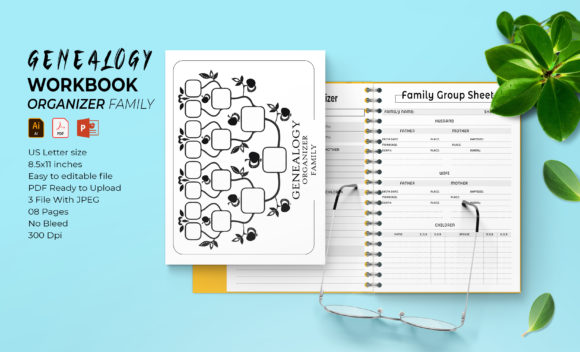
The Genealogy Organizer Workbook for Family is built around the fundamental pillars of genealogical research. It provides not just blank pages, but intelligently designed frameworks that guide your work. The Generational Family Tree section offers a visual anchor, allowing you to map relationships across time in a clear, hierarchical format. This isn't simply a chart; it's the backbone of your research, helping you identify gaps and understand lineage flow.
Crucially, the workbook includes dedicated organizers for both the Father Side and Mother Side. This separation acknowledges a common research approach and helps prevent the mixing of lineages, which can confuse later analysis. The Family Group Sheet is another vital component, focusing on the nuclear family unit. It prompts for exhaustive details on spouses, children, and events, ensuring each family "cell" is documented with depth and consistency.
Beyond Data: Capturing the Human Story
Perhaps one of the most valuable inclusions is the section titled Questions To Ask Your Family. Genealogy is more than dates and places; it’s about stories, personalities, and historical context. This curated list of prompts helps you conduct productive interviews, encouraging relatives to share memories, anecdotes, and personal insights that would never appear on a official certificate. This transforms your project from a dry data set into a rich, narrative family history.
The practical utility extends to the Name Born List, a simple but often overlooked tool for tracking individuals across documents. Combined, these sections ensure that every aspect of your research—from hard facts to soft stories—has a designated, organized place to be recorded.
Practical Applications and Outcomes for Different Users
The utility of the Genealogy Organizer Workbook for Family adapts to the user's specific goals. For a beginner, it serves as a friendly guide and a confidence builder. The predefined structures eliminate the "how do I start?" anxiety and provide a clear, step-by-step path forward. The outcome is immediate progress and the avoidance of early-stage frustration.
For the intermediate researcher with accumulated but disorganized notes, the workbook acts as a consolidation tool. It offers a uniform standard into which scattered information can be transferred, revealing connections and inconsistencies that were previously hidden. The outcome here is clarity and the ability to advance research with a clean, reliable dataset.
For the advanced family historian or someone wishing to publish or share their findings, the workbook’s design-ready format is key. Provided as a fully editable vector file in formats like Illustrator AI and PowerPoint PPT, it allows for customization. You can adjust colors, resize elements, and integrate your completed research into a polished, professional document suitable for printing or digital sharing. The outcome is a presentable heirloom—a book, a PDF, or a framed tree—that can be gifted to family members, preserving the work for generations.
Key Considerations and Recommendations for Implementation
To maximize the benefits of the Genealogy Organizer Workbook for Family, consider a few practical recommendations. Start by focusing on one lineage—perhaps your paternal side—using the dedicated organizer. Completing one section fully will give you a sense of accomplishment and a template for proceeding. Utilize the "Questions To Ask Your Family" list during phone calls or visits, recording answers directly into the workbook to maintain continuity.
Regarding the technical features, the fact that the package includes a print-ready PDF with no bleed means it is perfectly suited for home or office printing. The high-quality 300 DPI resolution ensures that any printed charts or sheets will be sharp and clear. For those with design aspirations, the editable vector shapes are a significant advantage. They allow you to maintain the professional layout while personalizing the workbook to match your family's story, perhaps by incorporating a family crest or changing color schemes to denote different branches.
Remember that genealogy is an iterative process. The workbook is designed to accommodate this. As you discover new information, you can return to your editable files and update them. This dynamic capability makes the Genealogy Organizer Workbook for Family a living document, evolving alongside your research.
A Tool for Connection and Legacy
Ultimately, the Genealogy Organizer Workbook for Family is more than a product; it is a methodology. It addresses the universal need to organize, preserve, and honor our personal histories. By providing a structured yet flexible framework, it empowers individuals to take control of their genealogical project, overcome common logistical barriers, and focus on the meaningful work of discovery. The outcome is not just a filled-out workbook, but a compiled heritage, strengthened family connections, and a tangible legacy that can stand the test of time. Whether you are a novice starting your first interview or a seasoned researcher ready to publish, this workbook serves as your dedicated companion, ensuring that every name, date, and story finds its rightful place in your family’s enduring narrative.