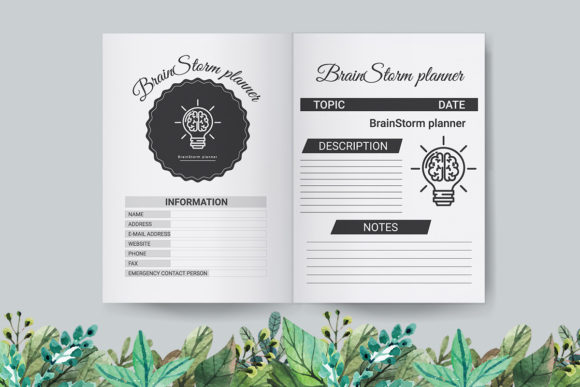
Your Unstructured Thoughts Need a Design BrainStorm Planner
Creativity isn't a neat, linear process. It's messy, chaotic, and full of fleeting ideas that vanish if they aren't captured. Whether you're a graphic designer sketching a new brand identity, a novelist wrestling with plot twists, or a startup founder mapping out a business model, your initial brainstorming is often the most vital—and most disorganized—phase. This is where a dedicated tool like the Design BrainStorm Planner transforms from a simple notebook into a strategic partner. It's a specialized KDP interior, a ready-to-upload PDF file with 100 pages formatted for the 8.5 x 11 inches trim size, designed specifically to give your unstructured brilliance a structured home.
Beyond the Blank Page: The Real-World Utility of a Brainstorm Planner
A blank journal can be intimidating. Its emptiness asks for everything but provides no framework. The Brainstorm Planner KDP interiors are different. They offer a contained, high-resolution workspace that psychologically cues your brain for productive ideation. This isn't about writing a daily to-do list; it's about creating a dedicated space for the "pre-work"—the raw, unfiltered thinking that happens before any project truly begins.
Scenario: The Solo Creative Professional
Imagine a freelance web developer tasked with redesigning a client's e-commerce site. The client's needs are a jumble of wishes: "more modern, but also classic, user-friendly but feature-rich." Starting in a Brainstorm Planner journal, the developer can rapidly sketch layout thumbnails on one page, jot competing aesthetic keywords on another, and list technical functionalities on a third. The planner allows these disparate threads to exist simultaneously without conflict. The strength here is visual and spatial organization; seeing all elements side-by-side often sparks connections that a linear document would miss. A potential limitation for some might be the physical format itself—if you're addicted to digital tools, the paper-based system requires a deliberate shift, but that tactile engagement can often deepen creative focus.
Scenario: The Collaborative Team Project
In a marketing team meeting for a new product launch, ideas fly fast. One person is talking about social media angles, another about video ad concepts, a third about press release hooks. Using a shared Design BrainStorm Planner as a central capture tool—whether passed around or used by a dedicated scribe—creates a unified artifact. Post-meeting, that single PDF or printed document becomes the canonical source of all raw ideas, eliminating the mess of individual notes on scattered sticky notes or digital files. It ensures no contributor's spark is lost and provides a clear, neutral base for the next phase of filtering and execution. The consideration here is scale: for massive, ongoing projects, a single 100-page interior might be one of several volumes, but it serves as a perfect, bounded container for each discrete brainstorming session.
The Diverse Audiences of a Structured Brainstorming Tool
The usefulness of this tool spans far beyond traditional "creative" fields. Its application is found in any process that requires generating, evaluating, and connecting ideas.
Academic Researchers & Students: Drafting thesis arguments, mapping out literature review connections, or brainstorming experimental methodologies. The planner helps combat the overwhelm of complex, multi-faceted projects by breaking them into visual components.
Small Business Owners & Entrepreneurs: Developing service offerings, solving operational bottlenecks, or planning marketing campaigns. The act of physically writing and drawing in a dedicated Brainstorm Planner KDP interiors book forces clarity and commitment, turning vague ambitions into actionable components.
Event Planners & Coordinators: Conceptualizing event themes, logistics flows, vendor ideas, and guest experience moments. The large 8.5 x 11 inch page provides ample space for timelines, mood boards, and lists to coexist.
Writers & Content Creators: Outlining blog series, developing character arcs, or brainstorming video script sequences. The linear format of a word processor can sometimes stifle the non-linear nature of storytelling; a planner allows for free-form association and spatial arrangement of plot points or content pillars.
Practical Considerations Before You Begin
Embracing a Design BrainStorm Planner is a commitment to a process. Before you upload that KDP-tested PDF or print your copy, a few practical reflections can maximize its benefit.
- Define Your Entry Point: Will you start with a massive, page-filling mind map? Or will you begin with simple, bulleted lists? Knowing your preferred entry style can help you navigate the first few pages without hesitation.
- Embrace Non-Perfection: This interior is for messy, first-draft thinking. Scribbles, crossed-out ideas, and half-formed sketches are its currency. The high-resolution design ensures clarity, but the content within should be imperfect.
- Pair with Digital Tools: The planner is a capture and connection device. Its output—the refined ideas—will often migrate to digital platforms for execution. Think of it as the optimal starting engine, not the entire vehicle.
- Assess Your Volume: The 100-page count is substantial. For a single project, it may be more than enough. For ongoing creative work, it becomes a serialized journal. Consider how you might date or tag sessions to create reference points for future review.
The Inherent Strengths and a Conscious Approach to Limitations
The primary strength of the Brainstorm Planner journal is its intentionality. It is a product designed for one thing: the fertile chaos of brainstorming. This specialization removes the distraction of other page layouts or functions. The KDP-tested, ready-to-upload format also means it's a professional, polished tool from the start, eliminating the time and effort required to design your own template.
A potential limitation, as with any physical tool, is portability and searchability. A digital note app can be searched by keyword; a paper planner requires manual review. This, however, can become a hidden benefit. The manual review process often leads to rediscovering forgotten ideas and serendipitous connections that an algorithmic search might overlook. The key is to understand its role in your workflow. It is the garden where ideas are planted and cultivated, not the warehouse where finished goods are stored and indexed.
From Captured Idea to Executed Project
Observing users of such planners, a common pattern emerges. The first 20 pages might be a torrent of unjudged output. The next 30 begin to show signs of organization—arrows connecting ideas, headings grouping concepts, priority marks. The final segments of the book often contain refined lists, selected directions, and actionable next steps. This evolution, documented in a single volume, provides not just a record of ideas, but a map of your thinking process itself. That metacognition—understanding how you think—is perhaps the most powerful long-term benefit. It turns the Design BrainStorm Planner from a simple project tool into a personal creativity audit, helping you become more efficient and effective in generating valuable ideas for every challenge you face.